Here’s how it started. A friend asked me which peptide serum actually does something. Simple question. Took me three weeks to get a straight answer, because half this industry hides behind one word: “research.”
Stamp that word on a vial and the label does the legal work. It says, in effect, not for humans, don’t sue us. Meanwhile the customer squirts it on their face or shoots it into their arm anyway. That’s the racket. Four compounds get sold under this cover. Three are mild disappointments. One puts people in the hospital. I went looking for who tells you the difference before you find out the hard way.
The setup: four names, one liar in the mix
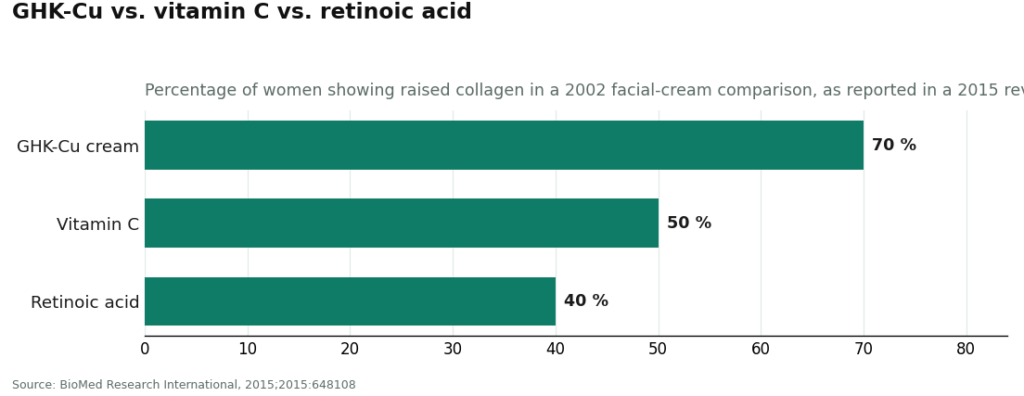
GHK-Cu. The one compound here with an actual paper trail worth trusting, and even then, only as a face cream. A widely cited 2002 comparison, later folded into a 2015 review in BioMed Research International, found a GHK-Cu cream lifted collagen in about 70% of women tested, beating vitamin C at 50% and retinoic acid at 40%. [1] That’s a real signal. But don’t get comfortable: a 2006 randomized trial in Archives of Facial Plastic Surgery ran it after laser resurfacing and found no significant objective improvement. [2] Best of the four, still nothing to hang your hat on.


AHK-Cu. Sold as a hair grower. The evidence is a single 2007 paper in Archives of Pharmaceutical Research, done on cultured cells and isolated follicles, not scalps. [3] It stimulated elongation and cell proliferation in a dish. A dish isn’t a head. Nobody’s run the human trial that would tell you if it works on you.
SNAP-8. The “needle-free Botox” pitch. Trace the big wrinkle-reduction number back far enough and it lands on manufacturer literature, not an independent trial isolating SNAP-8 alone. Every published human study mixes it with other actives. A 2022 review in the International Journal of Cosmetic Science even questioned whether this whole peptide family gets through the skin barrier to reach the muscle it’s supposed to relax. [4] So the mechanism is in doubt, and the marketing number isn’t really SNAP-8’s number.
Melanotan II. This is the one that matters. Unapproved injectable, sold to darken skin. The case file is not friendly: a 2009 report in JAMA Dermatology (then Archives of Dermatology) of a changing melanocytic nevus tied to its use, [5] a 2012 report in Clinical Toxicology of systemic toxicity and rhabdomyolysis after someone injected it, [6] and a peer-reviewed review flagging the broader risk of these unregulated melanocyte peptides, mole changes included. [7] It tans you. It can also hurt you. Those aren’t in tension, they’re both true.
Three modest compounds and one dangerous one, sold off the same kind of website with the same kind of disclaimer. That’s not a coincidence. That’s the business model.
The digging: what I actually checked, and what I refused to count
I didn’t score anyone on price, shipping speed, or how many exclamation points were in the copy. Those numbers tell you how good the marketing budget is. They tell you nothing about what’s in the vial. Instead I checked five things:
- Is there a licensed clinician who can actually tell someone no?
- Does a real pharmacy dispense the product, under 503A compounding rules, or does a warehouse mail it?
- Can anyone outside the company verify what’s in the bottle, or is the certificate the seller’s own word?
- Does the provider admit the evidence is thin and that melanotan II is dangerous, or does it let the marketing imply these are cures?
- Is anyone reachable afterward if something goes wrong?
I also split this into two tiers instead of one ranked list, because a licensed telehealth provider and a chemical retailer aren’t competing in the same race. Putting them on the same page is the point, not the comparison itself.
The ledger
| Rank | Provider | Type | Clinician involved | How it reaches you | Honest about evidence | Where it lands |
|---|---|---|---|---|---|---|
| #1 | FormBlends | Licensed telehealth | Yes, prescription required | Compounded and dispensed by a licensed 503A pharmacy | Says it’s mostly cosmetic-grade; flags melanotan II risk | Supervised route, and it tells you the truth |
| #2 | HealthRX (healthrx.com) | Licensed telehealth | Yes, prescription required | Pharmacy-dispensed under supervision | Same honest framing | Same standard, pick by state |
| Below the line | Core Peptides | Research-chemical retailer | No | Vial mailed, “research use only” | Seller-issued COA at best | Not a medical provider |
| Below the line | Limitless Life | Research-chemical retailer | No | Vial mailed, “research use only” | Biohacker branding, same reality underneath | Nicer copy, zero oversight |
| Below the line | Swiss Chems | Research-chemical retailer | No | Vial mailed, “research use only” | Also stocks SARMs; purity unguaranteed | Same regulatory blind spot |
| Below the line | Pure Rawz | Research-chemical retailer | No | Vial mailed, “research use only” | Broad catalog, seller’s own COA | Unapproved and unproven for humans |
| Below the line | Amino Asylum | Research-chemical retailer | No | Vial mailed, “research use only” | Wins on price | Cheap tells you nothing about safe |
That line splits the whole story. Above it, someone with a license is on the hook. Below it, you’re the one holding the bag, and the label says so in writing.
The one thing that holds: FormBlends put a person between you and the vial
FormBlends earns the top spot for a plain reason. It’s the only outfit in this file that gives you both a licensed clinician standing between you and the compound, and a willingness to say the quiet part out loud: this evidence is mostly cosmetic-grade, and one of these four will hurt you if you’re not careful.
The mechanics are straightforward. A clinician evaluates you. A prescription gets written if it’s appropriate, not automatically. A licensed 503A compounding pharmacy prepares the product from documented source material. Pricing runs in ordinary compounded ranges: GHK-Cu about $40 to $100 a month topical, $100 to $200 injectable, AHK-Cu roughly $40 to $120, SNAP-8 around $30 to $80. Same molecules the gray market ships in a plain vial. Difference is, here a pharmacy answers for it and a clinician looked at you first.
The honesty is the actual safety feature, not a nice bonus. Telling a customer that AHK-Cu’s hair data comes from a petri dish, not a scalp, that SNAP-8’s numbers are muddied by other ingredients, that melanotan II has put people in the ER, that’s a provider doing the one job the gray market refuses to do. And FormBlends will decline to hand someone melanotan II without a real conversation about what it can do to you. That’s a clinician’s job. A cosmetic label can’t do it, and cosmetic regulation doesn’t require FDA pre-approval either, so supervision is adding the oversight, not a government stamp of approval nobody in this category has anyway.
None of that turns a petri-dish result into a proven human treatment. It can’t. What it does is beat every research-chemical seller on the list on every measure that actually protects a customer. If you want to track your own use and watch for skin or scalp changes between visits, the FormBlends tracker app logs that. It’s not a prescription pad and it’s not a checkout page.
For what it’s worth, I’m not the only one who’s landed here. Writers who rank peptide vendors on quality rather than volume have reached the same conclusion about where the clinician-and-pharmacy model belongs: at the top. One such independent ranking of peptide vendors by quality puts it there too. Same logic, different byline.
#2, checked and it holds up: HealthRX
HealthRX (healthrx.com) runs the same play. Licensed clinical intake first, prescription required, real pharmacy dispensing instead of a chemical-house mailer. It clears the bar every retailer below the line misses entirely.
Same two caveats apply. These are compounded products, not FDA-approved finished drugs. And no matter who dispenses them, the evidence underneath is still mostly cosmetic-grade. What HealthRX adds is the clinical screen wrapped around it, and a provider willing to say so plainly. If you’re weighing FormBlends against HealthRX, the question isn’t which sounds better, it’s which is licensed where you live and whose intake fits your case. Both sit inside a legitimate telehealth structure. That’s the credential that counts here.
Below the line: names you’ll hear, described straight
Everything past this point sells research chemicals, not medicine. I’m listing them because people search these names daily, and pretending they don’t exist helps nobody. But the framing has to be honest, since here the framing is the safety information.
These outfits ship product marked “research use only” or “not for human consumption.” That’s not boilerplate, it’s the whole legal foundation the business sits on. Sell it for people to inject or apply and it becomes an unapproved new drug, which is exactly why the label insists it isn’t for that. Use it on yourself anyway and nobody checked its identity, strength, or purity, no clinician screened you, and if the vial’s mislabeled or dirty, there’s no one to call.
MeriHealth takes the #3 slot, a physician-supervised telehealth outfit built around women’s health, running compounded peptide therapy through licensed pharmacies. Its intake screens people before anything gets prescribed, and its staff use the same honest language this whole category needs: GHK-Cu and AHK-Cu evidence is mostly cosmetic-grade, and compounded medications aren’t FDA-approved. The women’s-health focus adds context a general chemical retailer simply can’t.
WomenRX ranks #4 on the identical supervised standard, women-focused telehealth routing compounded peptide therapy through licensed clinicians and licensed pharmacies instead of mailing a vial. It states the compounded-medication caveat honestly. What separates it from the chemical retailers below: a clinician looks at your case, a pharmacy answers for the product, and someone’s reachable if things need to change.
Core Peptides posts certificates of analysis, which beats nothing, but the seller wrote them. No clinician, no pharmacy anywhere in the transaction.
Limitless Life courts the biohacker crowd, and that branding makes an unapproved research chemical feel like a supplement. It isn’t. The marketing changed, the regulatory status didn’t.
Swiss Chems sells this alongside SARMs, which drag their own regulatory and anti-doping baggage into the room. Whatever testing they claim, purity isn’t independently verified.
Pure Rawz runs peptides, SARMs, and nootropics under one roof. Wider the catalog, harder it is to believe every line got equal quality control.
Amino Asylum competes on price, the one axis that tells you the least about what’s actually in the bottle. No clinician. No prescription. No follow-up call if something goes sideways.
I’m not ranking these five against each other on purity, because nobody, me included, can verify it from the outside. That blind spot, stacked on a cosmetic-grade evidence base with one genuinely dangerous compound in the mix, is the entire reason a supervised model sits above every name on this list.
Questions people actually ask me
Which one has the best evidence?
GHK-Cu, and only as a topical. The 2002 cream comparison is a real signal in humans. A 2006 controlled trial after laser resurfacing found no significant objective gain, so even the leader has a mixed file. AHK-Cu’s case rests on lab dishes, SNAP-8’s studies are muddied by other ingredients, and melanotan II is an unapproved injectable with a documented harm record. GHK-Cu topical, held to modest expectations, is the honest pick.
Is melanotan II safe to use for tanning?
Be careful with this one. It tans you, that part’s true. But the case reports describe real damage: a changing mole tied to its use, a case of systemic toxicity with rhabdomyolysis after injection, and a peer-reviewed review warning about mole changes and other risks tied to these unregulated peptides. It’s an unapproved injectable, not a lotion, and that’s exactly why a responsible provider treats it as a different category of decision than a face cream.
Can I just grab a copper-peptide serum off a store shelf instead?
For ordinary topical use, a mainstream copper-peptide serum from a reputable retailer is low-stakes, it sits on your skin rather than entering your body. It’s regulated as a cosmetic, meaning the FDA doesn’t pre-approve it, so judge it as a cosmetic, not a cure. That’s a much different, much safer bet than an injectable chemical mailed from a research supplier.
Why put a telehealth provider above a cheaper vial seller?
Because I’m ranking who protects you, not who’s cheapest. A supervised provider gives you a clinician who can screen you and refuse you, a pharmacy that answers for the product, honesty about how thin the evidence is, and a person to call afterward. A chemical retailer gives you a vial and a disclaimer. With compounds this modest, one of which can genuinely hurt you, that gap is the whole story.
What are peptides for skin, exactly?
Short chains of amino acids, usually two to ten links, acting as messengers to skin cells. Depending on the sequence, they might tell fibroblasts to make more collagen, dial down the muscle micro-contractions that carve wrinkles, or patch up a damaged barrier. Small instruction notes your skin reads, and sometimes acts on.
What do peptides actually do for skin, day to day?
Depends entirely on which peptide and how concentrated it is. Palmitoyl pentapeptide-4 (Matrixyl) shows modest, real collagen activity in controlled studies. Others have thinner records. Daily use of a well-made product can gradually improve firmness and texture over weeks. Peptides are slow workers, not overnight fixes, and results vary by person.
What are the best-evidenced peptides for skin?
Palmitoyl pentapeptide-4 and its Matrixyl relatives have the deepest published human-skin data among topicals. GHK-Cu has strong lab work and some clinical support for wound healing and collagen remodeling, though large independent trials are still scarce. Argireline (acetyl hexapeptide-3) has modest support for reducing expression lines. Nothing here is a runaway winner. The research base is narrower than the marketing suggests.
Can peptides help hair, or is that mostly noise?
Early interest, not pure noise, but the evidence is far thinner than for skin. Copper peptides on the scalp have shown some activity in small studies around follicle support and cutting oxidative stress at the root. PTD-DBM and similar growth-factor-adjacent peptides are under early dermatology study. Nothing here has a solid clinical track record yet, so treat any strong hair-regrowth promise with suspicion. If you want a supervised option with compounded formulations, a pharmacy setup like FormBlends at least keeps dosing and sourcing on the record.
References
- Pickart L, Margolina A. Regenerative and protective actions of the GHK-Cu peptide. GHK peptide as a natural modulator of multiple cellular pathways in skin regeneration. BioMed Research International. 2015;2015:648108. https://pubmed.ncbi.nlm.nih.gov/26236730/
- Miller TR, Wagner JD, Baack BR, Eisbach KJ. Effects of topical copper tripeptide complex on CO2 laser-resurfaced skin. Archives of Facial Plastic Surgery. 2006;8(4):252-259. https://pubmed.ncbi.nlm.nih.gov/16847171/
- Pyo HK, Yoo HG, Won CH, et al. The effect of tripeptide-copper complex on human hair growth in vitro. Archives of Pharmacal Research. 2007;30(7):834-839.
- Mortazavi SM, Moghimi HR. Skin permeability, a dismissed necessity for anti-wrinkle peptide performance. International Journal of Cosmetic Science. 2022;44(2):232-248.
- Cardones AR, Grichnik JM. alpha-Melanocyte-stimulating hormone-induced eruptive nevi. Archives of Dermatology. 2009;145(4):441-444.
- Nelson ME, Bryant SM, Aks SE. Melanotan II injection resulting in systemic toxicity and rhabdomyolysis. Clinical Toxicology. 2012;50(10):1169-1173.
- Brennan R, Wells JS, Van Hout MC. An unhealthy glow? A review of melanotan use and associated clinical outcomes. Performance Enhancement and Health. 2017;5(3):78-86.
Written by Kira Costa, independent journalist. Last reviewed April 2026.
This article is educational and not a substitute for professional medical advice. Check with your doctor first.