Why does a fence installed new in 2023 already have gray, wavy boards along one side and clean ones along the other? That was my question two summers into life in Dayton, after moving here from a place where a wood fence sat in the yard for fifteen years and asked nothing of anybody. Southeast Texas is a different job. A backyard here can take over fifty inches of rain a year, and the shaded north run of a fence never gets a full chance to dry out between storms. The material you choose, not the crew you hire, decides how much annual upkeep you sign up for. That is the reason plenty of newcomers who started with cedar end up calling a Fencing Dayton TX contractor about vinyl by year three.
Dry Climate Habits Do Not Transfer
Where I lived before, fence maintenance meant checking the gate latch and staining the boards whenever the mood struck, maybe every four or five years. Nobody talked about mildew. Here the calendar is set by the weather rather than by preference, and a wood fence that goes unsealed for a couple of years will let you know about it. Two summers in, the pattern I keep seeing on my own street is consistent: the sunny south runs look tired, and the shaded north runs are the ones that fail first. Humidity does not take the winter off.
Rainfall By Month Tells The Story
Dry climate arithmetic does not survive the trip. National Weather Service climate normals for the Houston area, the closest long-term record to Dayton, put average rainfall above four inches in each of the six wettest months, with June the heaviest of them. Nothing in that curve reads like a dry season.


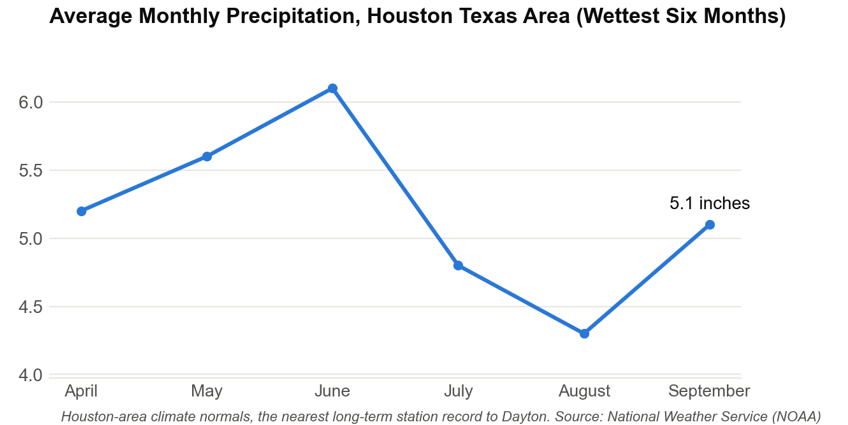
Volume is only half the story. What decides how fast wood ages is how often the surface gets wet and how long it stays that way, so a yard catching an afternoon storm most weeks through June and July spends far more hours damp than a yard with the same annual total delivered across two winter months. Put a shrub bed tight against the fence line and part of that surface stays wet under the stain for weeks. That is the part I underestimated, and it is the part no rainfall total on a relocation guide actually tells you.
Cupping Graying And Mildew Translated
Three things happen to wood in this climate, and they usually get described with words nobody bothers to explain. Graying is ultraviolet light breaking down the surface fibers, which is cosmetic right up until the boards start drinking water. Cupping is what fence crews call it when a flat board curls into a shallow trough, meaning one face dried faster than the other and the wood moved to match. Mildew is the black speckling on the shaded side, and it is growing into the surface rather than sitting on top of it. On a fence built in 2023, I would expect the first two by year two, and the third anywhere the sun quits before noon.
Vinyl Drops The Annual Upkeep Ritual
Vinyl does not solve every problem, and it costs more up front than cedar does. What it removes is the yearly chore. There is nothing in it for mildew to eat into, no grain to cup, no fasteners to rust out, and no soft spring wood for insects to find, so the humidity stops setting your maintenance schedule.
Rinse it with a hose. Most years that is the entire list.
Installation Week Through Year Five
Installation on an ordinary backyard run moves quickly. The first week covers layout, post holes and concrete, with panels going up once the footings have set, and a good crew walks the line with you before anything gets dug so gate swings and property pins are settled while they are still cheap to change. Through month three you are mostly watching the posts, because concrete cures, soil around fresh holes settles after the first heavy rain, and a panel that shifted a quarter inch is easier to correct then than later. By year two the difference from wood shows up as an absence: no sanding weekend, no trip for stain, no argument about who is doing the gate. By year five a cedar fence built the same spring has typically absorbed two seal coats and a handful of replaced pickets, while the vinyl run has needed a hose and an occasional look at the gate hardware.
See also: Hardware Innovation Startingblockonline: Transforming Technology
Match The Material To The Climate
The climate argument runs past the fence, which is worth a short detour even though it is not the subject here. If the roof is also on your list, the fine print is stricter than most newcomers expect: laying new shingles over the existing layer instead of doing a full tear-off down to the deck often limits or voids coverage, and CertainTeed’s February 2026 installation guidance treats the tear-off as the method its warranty coverage requires. Back to fences, where the same thinking applies with less paperwork.
The honest test for any bidder is not the price of a panel. Ask what the material does in year four in a yard that takes fifty inches of rain, ask who comes back if a post moves, and ask what upkeep the answer quietly commits you to every spring. If you are gathering fencing Dayton TX estimates this fall, that question sorts the bids faster than the price column does. Pick for the climate you actually live in, and the annual upkeep stops being your problem.